A Google Blog

Showing posts with label Law. Show all posts

Saturday, July 02, 2016

Florida Parents have fewer rights than those accused of criminal offenses.

"These are my Babies" is just the first of a series of videos that will be used to train parents that take classes to learn their rights so that they don't face the loss of their child and their resources at the alarming rate that has become common in divorce and child custody modification suits without the same level of protections that a common criminal would receive.

Hostile attorneys are causing parents and children to lose their fundamental rights, and may be causing children more harm.
Where do you start to protect yourself and your child?
  1. You get this book
  2. Then you take these classes
If you want to talk to Sherry or Ron B Palmer personally contact them here:

If you want Mike and Melody to make a video for you for your business you can contact them here:

We have workshops coming up in Florida, Sacramento, Dallas, and Washington D.C. info@fixfamilycourts.com


As per Administrative Order No. AOSC14-66, I would like to request a detailed investigation as to abuses of power and violations of conduct displayed by three Judges involved in Case No.: 11-21207-FC-04, FAMILY DIVISION. I believe that their actions clearly amount to violations of public trust, neglect of duty, and ethics which, as recently stated in this unprecedented administrative order by Florida’s chief justice, Jorge Labarga, shall carry consequences to those involved.

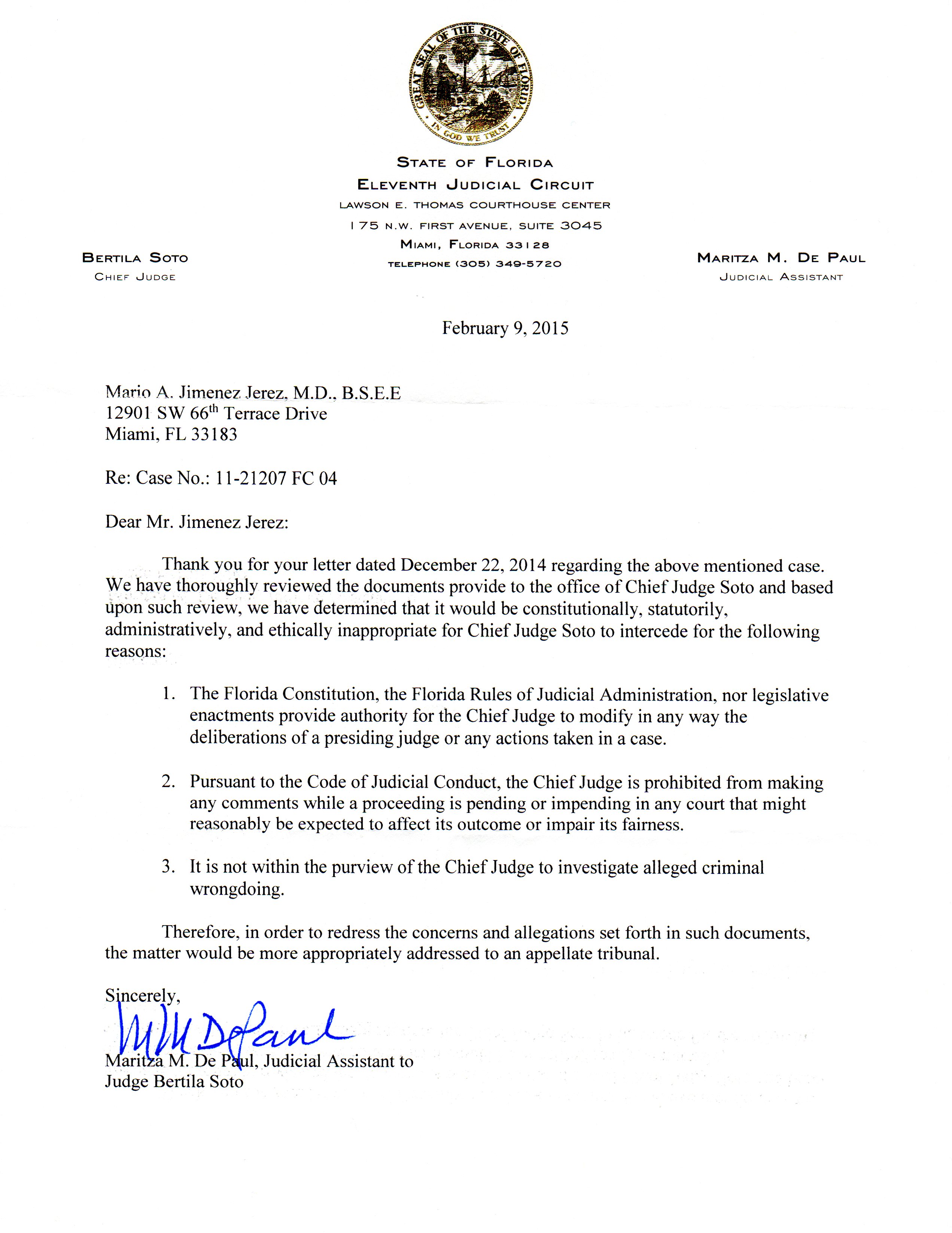
Her reply, I believe, amounts to Contempt of Court of Administrative Order No. AOSC14-66 issued by Florida Chief Justice, Jorge Labarga. I am planning to file a motion for Contempt of Court before the Florida Supreme Court, and anyone who has received a similar response from their circuit chief judge should consider doing the same. We need to make these judges accountable for their actions or lack thereof. This is the only way they will start to pay attention to We, The People. Say NO to PAS

Did your Chief Judge ignore Florida Chief Justice administrative order No. AOSC14-66? Mine did, so she is in contempt of court.

    
Chief Judge

See original letter sent to 11th Circuit Chief Judge, Bertila Soto, here: Say NO to PAS
December 22, 2014
Honorable Bertila Soto
11th Judicial Circuit, Chief Judge
Lawson E. Thomas Courthouse Center
175 NW 1st Ave. Room Number CHC 3045
Miami, FL 33128
(305) 349-5720

Dear Honorable Bertila Soto,

I am a born-again Christian man, who for the Glory of God in Christ Jesus, became an American Board of Family Medicine certified physician (from UM/JMH, with highest medical training score in the program, among top in the nation, named team player of the year by my 2013 class, highly praised by my peers and our community in general), an Electrical Engineer (from FIU, Cum Laude), an ex-Olympian, and a father of four, two of which came from my first marriage.

If I had not lived it in my own flesh, I probably would have never believed what I am seeing unfolding in our Family Courts today.

As my dealings with the three Judges I am reporting in this letter exemplify, some Judges routinely ignore the rule of law, the constitution, due process, and common sense, and selectively enforce the law for their own interest or that of their friends calling it “the best interest of the children.” In my experience with a dysfunctional Family Court, I am appalled to find out that the moment one walks into it, one is immediately stripped away of our constitutional rights, such as our rights to freedom of religion, speech, self-incrimination, due process, jury trial, and equal protection.

It is a place where parents have fewer rights than known criminals in other courts...

...for if a criminal cannot afford an attorney, one is assigned to them; a place where the law provides more rights to protect one’s property or debts than to protect one’s children. In all cases, parents are left at the whims of Judges who regularly have conflicts of interests, whose campaign funds or the certainty of not having someone run against them is owed to the same attorneys who come before them.

As taught to view medicine by Dr. Lynn Carmichael, one of my heroes and founder of Family Medicine, from an integrative medicine perspective, I believe that the problems in our Family Courts represent not only a judicial emergency, but a true health crisis. As my case also exemplifies, the negative effects of our currently dysfunctional Family Courts routinely lead children and adults to suffer not only from serious mental issues such as major depression, anxiety, post traumatic stress disorder, and many others, but in a large enough number of unfortunate cases, can also lead to suicides, homicides, and a number of other serious crimes, not to mention, the enormous economic cost that it brings to our societies from broken homes and lives.


While attending medical school in Nicaragua, my ex-wife absconded for two years with my two kids (Mario was 7 y/o and Nicole was 4 y/o at that time), with the intervention of the American Embassy, the U.S.A. State Department, Miami-Dade police investigators, and even the FBI, I was able to recover them and restore shared custody of my kids by Judge Robert Scola. As ordered by Judge Scola, for about a year, my whole family and I worked very hard to reintegrate the children to our lives. I also immediately recruited the help of a licensed children’s psychologist for intensive weekly therapies, and my children adapted well to their new environment. My Son, Mario, for instance, went from failing third grade and scoring in the lowest quartile in his FCAT to becoming an A/B student, scoring in the top quartile in the FCAT, and being given the honor of student of the month (one of the proudest moments of his and my life).

Friday, September 04, 2015

Don't Duke it Out With the Rude and Abrasive Judge!!

Suggestions for Interacting With Family Court Judges

  • Rule #1: Be Prepared

Judges have little patience with attorneys, and self-represented litigants, who aren't prepared when they enter the courtroom. Many litigants don't seem to know what they are asking the court to do, why they are asking for it, and what the best legal or factual grounds are for the orders requested. Courts everywhere, but particularly here in California with the passage of Family Code section 217 (which requires live testimony hearings upon request) , are overburdened. Judicial resources are not sufficient to meet demand in these budgetary times, and this places a premium on directness and efficiency. Economic limitations also makes judges a lot crankier than if they had more resources to manage their caseload and calendars.

Depending on County size, wealth and population, California Family Law Judges typically have between 20 and 35 or more matters on their morning calendars. In the afternoons they are often holding evidentiary hearings and trials. If they are to move through these calendars by the end of the morning, brevity and efficiency becomes exceedingly important.

Therefore, one of the biggest mistakes that agitates judges is parties or lawyers who aren't prepared and so can't present their cases with clarity. If a lawyer doesn't appear to care overmuch about their client's case, then why should a judge? Lack of preparation, especially for lawyers, is a cardinal sin.

  • Rule #2: Be Prepared For This Particular Judge

In jurisdictions with direct calendar assignments, where a judge is assigned to a case for all purposes or for all purposes possibly until the case is reassigned for trial, learn about the particular bench officer(s) who presides over your case. Information allows you to make useful assumptions about a particular judge's attitudes and policies.

As Judges Curtis and Zisman note, the best judicial officers are predictable and consistent in their rulings. "A judge's value to the public as a judge is in direct proportion to the ability of the lawyers who frequent the court to predict how the judge will deal with a particular issue." I find this to be so true in my personal experience. Lawyers who know how judges tend to rule on a given issue can set their client's expectations realistically. Armed with such knowledge, both sides are in a better position to have productive settlement discussions that avoid a "crapshoot" and the associated risks and expense. They don't potentially infuriate bench officers with weak arguments that, it is known, such judges may rarely accept.

Lawyers who are practitioners in any given court usually have good insights into local judge's attitudes. They may also be aware of information about a judge that is not generally available to the public, like their expertise, practice focus, and reputation before they took the bench. Knowing that while a lawyer your judge participated in a case that generated a published appellate decision on a move-away case, for instance, could provide you a wealth of ideas on how to tailor your presentation. Likewise, knowing whether a judge has been reversed is useful for making sensitive presentations.

Pro per litigants should consider observing a judge going through her calendar over the course of one or more days. You will learn tons about their judicial attitude from watching them in open court, and you may witness other parties get scolded or reprimanded for missteps and so avoid the same mistakes. A simple but classic example is the family court litigant who brings a small retinue of family members who are there to provide familial support, some of whom cannot sit still without gasping, shaking their heads violently, or sobbing.


  • Rule #3: Notify the Court If the Case Will Be Continued the Day Before

Sometimes one or both attorneys or parties intend to seek a continuance of a hearing, possibly because they want to discuss settlement but often because one or both are not ready to proceed or have late papers to submit.

Judges have very different attitudes towards continuances, particularly where they have already read the materials and then are faced with a continuance request. Lawyers who know that a case will not proceed are well advised to contact the courtroom clerk at least a day in advance to give a head's up - otherwise, they may wind up with a judge who justifiably feels "put out". Some allow self-represented parties to give advance notice of agreed upon continuances, but the other side will need to confirm it. Often messages must be left on the clerk's answering machine, and you may not know that number or whether messages were received or acted upon.

Where both sides have attorneys and a particular judge is known to permit it, counsel should always let the court know one or even two days in advance that the hearing is not expected to proceed that day.

  • Rule #4: Look At the Local Court Rules, If Any, and the California Rules of Court

Some counties or individual courts have local rules; many do not. Most judges have their own rules and styles, often never to be found in written form. It never hurts to ask the Court clerk, when the judge is off the bench, whether that courtroom follows any specific preferences, customs, or rules of procedures.

The state-wide source for procedural rules impacting California Family Law (and Juvenile cases) are the California Rules of Court, beginning with Rule 5.100. Rule 5.111 is one of the immediately most important, since it deals with initiating common OSC and Motion requests for custody, support, etc. These rules apply to all family law matters in all California courtrooms.

The Riverside County Local Rules pertaining to Family Law cases can be found here. Start with Title 5I discuss these in more detail below. The Los Angeles Family Court Rules can be accessed here. Basically you ought to go to the County website where your case is filed and look for the local rules for that are applied.

  • Rule #5: Talk to the Judge, Not the Other Party or Lawyer

The time to discuss your case or argue with the other side is before you enter the courtroom. It drives judges nuts when two lawyers, two pro se parties, or any combination of them begin to argue at counsel table as though the judge was not present. Keep your focus on the judge, and generally avoid looking at the other party except for emphasis. Never address the other party directly.

If you bring witnesses or support people in the courtroom, tell them in advance to keep control of themselves. This means no interruptions, no head shaking or head nodding, no gasps, and no agitated movements. It is natural that such people have an emotional investment in the outcome. However, if they act in an uncontrolled fashion, that may affect the court's evaluation of you. I don't have many times I told family members this, only to watch them go utterly vacant and stupid because their emotions get out of hand!

A Google Blog

Means we use must be as pure as the ends we seek.

Abuse (7) Abuse of power (1) Abuse of process (5) Admission to practice law (3) Adversarial system (84) Advocacy group (3) African American (1) Alienator (1) Alimony (7) All Pro Dad (2) All rights reserved (1) Allegation (2) Alliance for Justice (2) American Civil Liberties Union (3) American Psychological Association (1) Americans (2) Anecdotal evidence (2) Anti-discrimination law (1) Arrest (1) Bar association (1) Best interests (42) Bill (law) (1) British Psychological Society (1) Broward County (1) Broward County Public Schools (3) Brown University (1) Catholic Church (1) Center for Public Integrity (2) Chief judge (26) Child Abuse (48) Child custody (76) Child development (4) Child neglect (3) Child protection (14) Child Protective Services (18) Child Support (62) Children (3) Children's Rights (85) Christine Lagarde (1) Christmas (3) Circuit court (3) Civil and political rights (14) Civil law (common law) (1) Civil liberties (9) Civil Rights (145) Civil rights movement (1) Class action (1) Communist Party of Cuba (1) Confidentiality (1) Constitutional law (1) Constitutional right (5) Contact (law) (11) Contempt of court (4) Convention on the Rights of Persons with Disabilities (1) Coparenting (31) Copyright (1) Copyright infringement (1) Corruption (1) Court Enabled PAS (95) Court order (2) Cuba (1) Cuban Missile Crisis (1) Cuban Revolution (1) Custodial Parent (1) custustodial Parent (1) Declaratory judgment (3) Denial of Reasonable Parent-Child Contact (117) Diagnostic and Statistical Manual of Mental Disorders (2) Divorce (123) Divorce Corp (5) Divorce Court (1) Documentary (24) Domestic Violence (51) Dr. Stephen Baskerville (5) Dred Scott v. Sandford (1) DSM-5 (1) DSM-IV Codes (1) Due Process (44) Due Process Clause (1) Dwyane Wade (1) Easter (1) Equal-time rule (2) Ethics (1) Events (9) Exposé (group) (1) Facebook (20) Fair use (1) False accusation (4) False Accusations (58) famil (1) Family (1) Family (biology) (2) Family Court (200) Family Law (112) Family Law Reform (118) Family Rights (87) Family therapy (10) Father (14) Father figure (3) Father's Day (1) Father's Rights (16) Fatherhood (109) Fatherlessness Epidemic (5) Fathers 4 Justice (3) Fathers' rights movement (48) Fidel Castro (1) Florida (215) Florida Attorney General (7) Florida Circuit Courts (19) florida lawyers (30) Florida Legislature (6) Florida Senate (11) Foster care (1) Fourteenth Amendment to the United States Constitution (1) Fraud (1) Free Speech (1) Freedom of speech (1) Frivolous litigation (1) Fundamental rights (14) Gainesville (1) Gender equality (1) Government Accountability Project (2) Government interest (2) Grandparent (4) Havana (1) Healthy Children (14) Human Rights (121) Human rights commission (1) I Love My Daughter (56) I Love My Son (9) Injunction (1) Innocence Project (1) Investigative journalism (1) Jason Patric (2) JavaScript (1) Joint custody (7) Joint custody (United States) (18) Judge (5) Judge Judy (7) Judge Manno-Schurr (56) Judicial Accountability (103) Judicial Immunity (7) Judicial misconduct (10) Judicial Reform (4) Judicial Watch (2) Judiciary (3) Jury trial (1) Kids for cash scandal (1) Law (2) Lawsuit (9) Lawyer (8) Legal Abuse (149) Liar Joel Greenberg (17) Linda Gottlieb (1) Litigant in person (1) Little Havana (1) Marriage (6) Matt O'Connor (1) Men's rights movement (1) Mental disorder (1) Mental health (2) Meyer v. Nebraska (1) Miami (44) Miami-DadCounty (1) Miami-Dade County (7) Miami-Dade County Public Schools (2) Miscarriage of justice (42) Mother (4) Motion of no confidence (1) Movie (4) Music (8) Nancy Schaefer (1) National Fatherhood Initiative (1) Natural and legal rights (1) News (86) Nixa Maria Rose (17) Non-governmental organization (1) Noncustodial parent (5) Organizations (58) Palm Beach County (1) Parent (37) Parental Alienation (119) Parental alienation syndrome (19) Parental Rights (37) Parenting (15) Parenting plan (6) Parenting time (6) Parents' rights movement (38) Paternity (law) (1) Personal Story (23) Pierce v. Society of Sisters (1) Pope (1) Posttraumatic stress disorder (29) President of Cuba (1) President Trump (1) Pro Se (28) Pro se legal representation in the United States (3) Prosecutor (1) Protest (1) Psychological manipulation (1) Psychologist (1) Public accommodations (1) Public Awareness (106) Raúl Castro (1) Re-Post/Re-Blog (12) Research (1) Restraining order (4) Rick Scott (12) Second-class citizen (1) Self Representation-Pro Se (31) Sexism (1) Sexual abuse (2) Sexual assault (1) Shared Parenting (93) Single parent (6) Skinner v. Oklahoma (1) Social Issues (60) Social Media (1) Spanish (8) Stand Up For Zoraya (48) State school (2) Student (1) Supreme Court of Florida (8) Supreme Court of the United States (5) Tampa (1) Testimony (23) Thanksgiving (1) The Florida Bar (10) The Good Men Project (1) Trauma (4) Troxel v. Granville (2) True Story (21) Turner v. Rogers (1) United States (26) United States Congress (1) United States Constitution (1) United States Department of Justice (4) Videos (49) Violence Against Women Act (1) Whistle-blower (3)