A Google Blog

Showing posts with label Miscarriage of justice. Show all posts

Saturday, December 10, 2016

JUDICIAL BIAS – A Fine Balance

Judicial bias refers to a situation where a judge's personal opinions, beliefs, or prejudices influence their decision-making in a case, rather than relying solely on the law, the facts presented, and fair legal principles. In an ideal legal system, judges are expected to be impartial, making decisions based on the law and the facts of the case at hand, without favoritism or prejudice. When a judge allows their personal biases to influence their decisions, it undermines the fairness and integrity of the legal process.

Judicial bias can manifest in several ways:

  1. Personal Bias: A judge may have personal beliefs or experiences that affect how they view a case. For example, a judge might show favoritism towards a particular gender, race, or social class in their rulings. In family law cases, this could mean favoring one parent over another due to gender-based assumptions about caregiving, even if the law doesn’t support such a preference.

  2. Prejudgment: If a judge has already formed an opinion about a case or a party involved before hearing all the evidence, this can lead to biased decision-making. For example, if a judge is publicly critical of one side (like mothers, fathers, or certain groups of people) in similar cases, it could create an impression that their mind is already made up, influencing their impartiality.

  3. Conflict of Interest: A judge might have a personal or financial interest in the outcome of a case, which can affect their neutrality. For instance, if a judge knows one of the attorneys personally or has a vested interest in a company or entity involved in the case, they may be more inclined to rule in a way that benefits that party.

  4. Cultural or Social Bias: Judges may unintentionally bring their own cultural or social background into the courtroom, affecting how they view the parties involved in a case. For instance, they may give less weight to the testimony of a person from a lower socioeconomic background or show favoritism toward a particular lifestyle or belief system.

  5. Inconsistent Rulings: If a judge applies different standards of judgment depending on the parties involved or the type of case (e.g., consistently ruling in favor of one gender or party in family law cases), that could be considered judicial bias.

Why Judicial Bias is Problematic

  • Unfair Outcomes: Judicial bias undermines the idea of a fair trial. If a judge's decision is influenced by personal views or prejudices, the result may not be just or equitable.

  • Loss of Public Trust: A judicial system that allows bias to affect its outcomes can erode the public’s confidence in the fairness and legitimacy of the law. If people believe that judges are not impartial, they may not respect the rulings or seek alternative means of resolving their disputes.

  • Appeals and Reversals: Biased decisions can lead to appeals, which are costly and time-consuming. Higher courts may overturn decisions based on judicial bias, leading to delays and additional burdens on the legal system.

How Judicial Bias is Addressed

  • Recusal: In cases where a judge has a conflict of interest or there is a concern about bias, they may recuse themselves (step aside) from the case to maintain fairness.

  • Appellate Review: Higher courts review lower court decisions to ensure that bias or errors in judgment did not influence the ruling.

  • Training and Ethical Guidelines: Judges are often required to undergo training on ethics, fairness, and bias. Many courts also have rules that prohibit judges from engaging in behavior that could lead to the appearance of bias.

Can Bias Be Avoided?

While it's impossible to completely eliminate personal influences, judges are held to high ethical standards and must avoid any conduct that would compromise their objectivity. Legal systems often have mechanisms like appeals, judicial review boards, and complaints processes in place to help address instances of bias.

In the context of family law, where emotions can run high (especially in divorce and custody disputes), there can be particular concerns about bias. For instance, if a judge has a bias towards mothers in custody cases, this could lead to unfair outcomes for fathers (or vice versa). Addressing this bias is crucial to ensuring that all parties receive equal treatment under the law.

Have you ever seen examples of judicial bias play out in real-world cases or media portrayals? How do you think courts could work to address this issue?

People also ask:

What is a biased judge?

bias. n. the predisposition of a judge, arbitrator, prospective juror, or anyone making a judicial decision, against or in favor of one of the parties or a class of persons. This can be shown by remarks, decisions contrary to fact, reason or law, or other unfair conduct.

Bias legal definition of bias - Legal Dictionary - The F

legal-dictionary.thefreedictionary.com/bias

When a judge has a conflict of interest?

Recuse. To disqualify or remove oneself as a judge over a particular proceeding because of one's conflict of interest. Recusal, or the judge's act of disqualifying himself or herself from presiding over a proceeding, is based on the Maxim that judges are charged with a duty of impartiality in administering justice.

Recuse legal definition of recuse

legal-dictionary.thefreedictionary.com/recuse

What is actual bias?

Bias may be actual, imputed or apparent. Actual bias is established where it is actually established that a decision-maker was prejudiced in favour of or against a party. However, in practice, the making of such an allegation is rare as it is very hard to prove.

Natural justice - Wikipedia, the free encyclopedia

https://en.wikipedia.org/wiki/Natural_justice
Search for: What is actual bias?

What are the circumstances under which a judicial officer may be required to disqualify himself from proceedings?

Judicial disqualification, also referred to as recusal, refers to the act of abstaining from participation in an official action such as a legal proceeding due to a conflict of interest of the presiding court official or administrative officer.

Judicial disqualification - Wikipedia, the free encyclopedia

en.wikipedia.org/wiki/Judicial_disqualification

Originally posted on Researching Reform:

The subject of judicial bias has always fascinated Researching Reform and in the family justice system, where discretion is not just an afterthought but a much-used tool, bias can be magnified and in turn can affect judgement.

Tuesday, September 27, 2016

Exposing The Methods An Alienating Parent Uses To Brainwash Their Child.

Isolation is the KEY to Manipulation.


Isolation. The act of isolating, or the state of being isolated, insulation, separation; loneliness.

Manipulation. A method of changing an individual’s attitudes or allegiances through the use of drugs, torture or psychological techniques, any form of indoctrination, alluding to the literal erasing of what is in or on one’s mind.
Brain Washing used to be associated exclusively with the act or practice of manipulating. The state of being manipulated. Shrewd or devious management, especially for one’s own advantage. Indirect control, as of an advisor; power to affect the opinions.

If you isolate the target You can say what you want about them. If you isolate the victim and only allow contact with allies you have complete control. This is an "Alienation Tactic".


Saturday, July 02, 2016

Florida Parents have fewer rights than those accused of criminal offenses.

"These are my Babies" is just the first of a series of videos that will be used to train parents that take classes to learn their rights so that they don't face the loss of their child and their resources at the alarming rate that has become common in divorce and child custody modification suits without the same level of protections that a common criminal would receive.

Hostile attorneys are causing parents and children to lose their fundamental rights, and may be causing children more harm.
Where do you start to protect yourself and your child?
  1. You get this book
  2. Then you take these classes
If you want to talk to Sherry or Ron B Palmer personally contact them here:

If you want Mike and Melody to make a video for you for your business you can contact them here:

We have workshops coming up in Florida, Sacramento, Dallas, and Washington D.C. info@fixfamilycourts.com


As per Administrative Order No. AOSC14-66, I would like to request a detailed investigation as to abuses of power and violations of conduct displayed by three Judges involved in Case No.: 11-21207-FC-04, FAMILY DIVISION. I believe that their actions clearly amount to violations of public trust, neglect of duty, and ethics which, as recently stated in this unprecedented administrative order by Florida’s chief justice, Jorge Labarga, shall carry consequences to those involved.

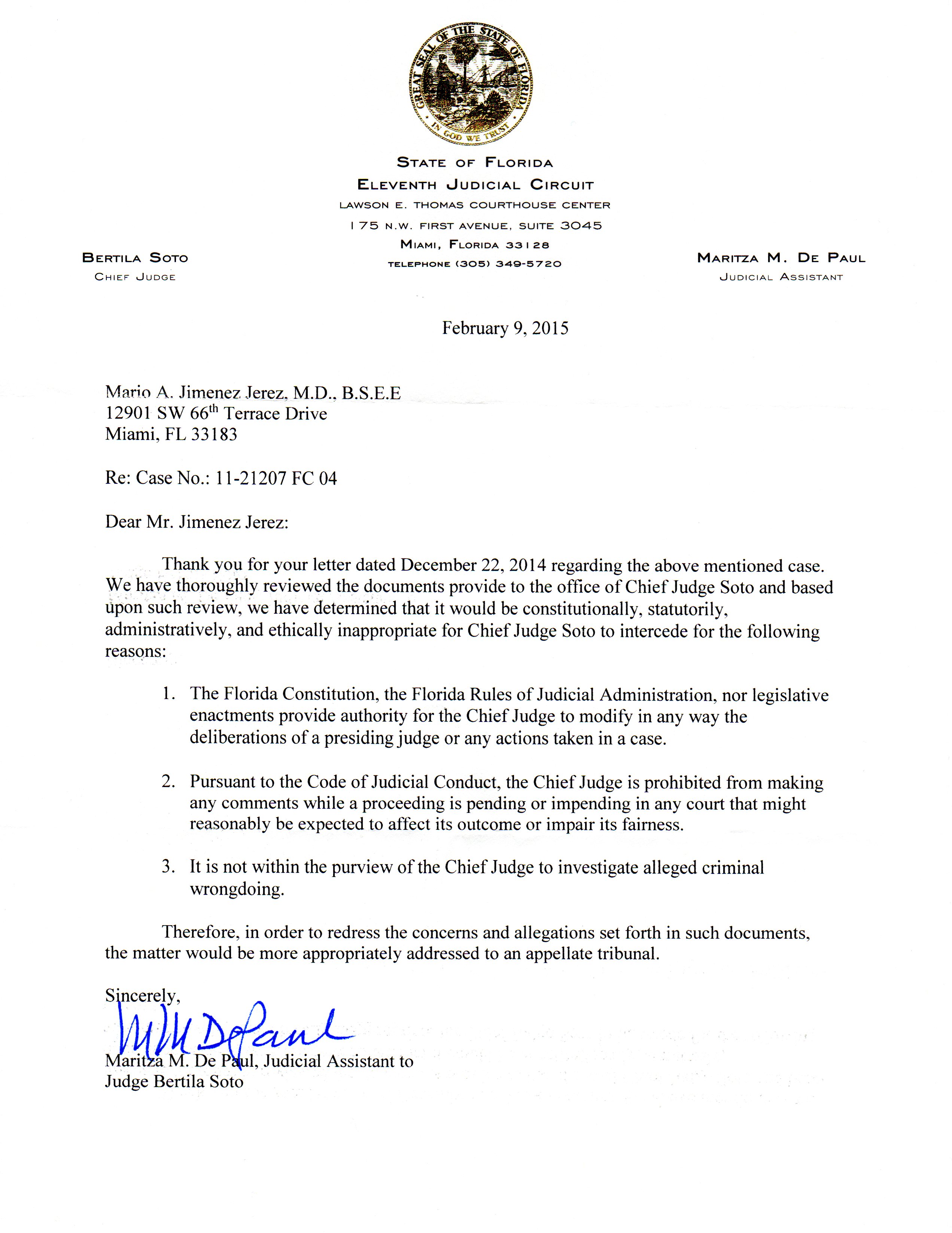
Her reply, I believe, amounts to Contempt of Court of Administrative Order No. AOSC14-66 issued by Florida Chief Justice, Jorge Labarga. I am planning to file a motion for Contempt of Court before the Florida Supreme Court, and anyone who has received a similar response from their circuit chief judge should consider doing the same. We need to make these judges accountable for their actions or lack thereof. This is the only way they will start to pay attention to We, The People. Say NO to PAS

Did your Chief Judge ignore Florida Chief Justice administrative order No. AOSC14-66? Mine did, so she is in contempt of court.

    
Chief Judge

See original letter sent to 11th Circuit Chief Judge, Bertila Soto, here: Say NO to PAS
December 22, 2014
Honorable Bertila Soto
11th Judicial Circuit, Chief Judge
Lawson E. Thomas Courthouse Center
175 NW 1st Ave. Room Number CHC 3045
Miami, FL 33128
(305) 349-5720

Dear Honorable Bertila Soto,

I am a born-again Christian man, who for the Glory of God in Christ Jesus, became an American Board of Family Medicine certified physician (from UM/JMH, with highest medical training score in the program, among top in the nation, named team player of the year by my 2013 class, highly praised by my peers and our community in general), an Electrical Engineer (from FIU, Cum Laude), an ex-Olympian, and a father of four, two of which came from my first marriage.

If I had not lived it in my own flesh, I probably would have never believed what I am seeing unfolding in our Family Courts today.

As my dealings with the three Judges I am reporting in this letter exemplify, some Judges routinely ignore the rule of law, the constitution, due process, and common sense, and selectively enforce the law for their own interest or that of their friends calling it “the best interest of the children.” In my experience with a dysfunctional Family Court, I am appalled to find out that the moment one walks into it, one is immediately stripped away of our constitutional rights, such as our rights to freedom of religion, speech, self-incrimination, due process, jury trial, and equal protection.

It is a place where parents have fewer rights than known criminals in other courts...

...for if a criminal cannot afford an attorney, one is assigned to them; a place where the law provides more rights to protect one’s property or debts than to protect one’s children. In all cases, parents are left at the whims of Judges who regularly have conflicts of interests, whose campaign funds or the certainty of not having someone run against them is owed to the same attorneys who come before them.

As taught to view medicine by Dr. Lynn Carmichael, one of my heroes and founder of Family Medicine, from an integrative medicine perspective, I believe that the problems in our Family Courts represent not only a judicial emergency, but a true health crisis. As my case also exemplifies, the negative effects of our currently dysfunctional Family Courts routinely lead children and adults to suffer not only from serious mental issues such as major depression, anxiety, post traumatic stress disorder, and many others, but in a large enough number of unfortunate cases, can also lead to suicides, homicides, and a number of other serious crimes, not to mention, the enormous economic cost that it brings to our societies from broken homes and lives.


While attending medical school in Nicaragua, my ex-wife absconded for two years with my two kids (Mario was 7 y/o and Nicole was 4 y/o at that time), with the intervention of the American Embassy, the U.S.A. State Department, Miami-Dade police investigators, and even the FBI, I was able to recover them and restore shared custody of my kids by Judge Robert Scola. As ordered by Judge Scola, for about a year, my whole family and I worked very hard to reintegrate the children to our lives. I also immediately recruited the help of a licensed children’s psychologist for intensive weekly therapies, and my children adapted well to their new environment. My Son, Mario, for instance, went from failing third grade and scoring in the lowest quartile in his FCAT to becoming an A/B student, scoring in the top quartile in the FCAT, and being given the honor of student of the month (one of the proudest moments of his and my life).

Thursday, December 31, 2015

Family Court ~ A Bizarre System Encourages Parents To Use Disturbing Tactics


With Steven Sumner Discussing

Bullied to Death:

Chris Mackney's Kafkaesque Divorce

Conservatives aren't just fighting same-sex marriage; They’re also trying to stop divorce?!

For years, social conservatives have been fighting to prevent certain people from getting married. But they’re waging a parallel battle, too: Trying to keep married couples together.

In cooperation with the Family Research Council and the National Organization for Marriage, socially conservative politicians have been quietly trying to make it harder for couples to get divorced. In recent years, lawmakers in more than a dozen states have introduced bills imposing longer waiting periods before a divorce is granted, mandating counseling courses or limiting the reasons a couple can formally split. 

States such as Arizona, Louisiana and Utah have already passed such laws, while others such as Oklahoma and Alabama are moving to do so.

If divorces are tougher to obtain, social conservatives argue, fewer marriages will end. And having more married couples is not just desirable in its own right but is a social good, they say. During his presidential campaign, former senator Rick Santorum (R-Pa.) emphasized finishing high school and getting married as cures for poverty. “If you do those two things, you will be successful economically,” he declared at a 2011 event in Iowa.

A legislative movement against divorce may seem like a non-starter in a country where half of married couples avail themselves of this right, but as with legal challenges to Obamacare and the rise of the tea party movement, today’s fringe idea can quickly become tomorrow’s mainstream conservatism.


Divorce has long been a cultural touchstone in America. Social conservatives regularly advocate a return to a more traditional system of divorce — namely that it be extraordinarily difficult to get. For example, the only way an Alabamian could get a divorce under the state’s original 1819 constitution: “No decree for such divorce shall have effect until the same shall be sanctioned by two thirds of both Houses of the General Assembly.” Even a battered wife — who, of course, couldn’t vote — would have to petition her all-male state legislature and get supermajority approval before being freed from matrimony.

For most of American history, to obtain a divorce, one party had to prove to a judge that the other party was at fault, meaning he or she had committed certain grievous acts that irreparably harmed the marriage, such as adultery or being convicted of a felony. Emotional or physical abuse wasn’t always enough; even adultery or abandonment could be insufficient if a spouse reluctant to get divorced convinced a judge that his or her partner was similarly culpable. And as historian Glenda Riley showed in her 1991 book “Divorce: An American Tradition,” loveless couples often found creative ways to persuade judges to end their marriages: As recently as the 1950s, some couples would stage a bust, complete with hotel room, “mistress,” photographer and private detective who would testify in court about the husband’s (or wife’s) supposed illicit deeds.


This system began to crumble during the 1960s. In 1969, California became the first state to legalize no-fault divorces — permitting divorce without requiring proof of wrongdoing such as adultery — in the Family Law Act, signed by Gov. Ronald Reagan. Within a decade, 45 other states had joined California. By 1985, 49 states had legalized no-fault divorce; New York did just four years ago.

No-fault divorce has been a success. A 2003 Stanford University study detailed the benefits in states that had legalized such divorces: Domestic violence dropped by a third in just 10 years, the number of husbands convicted of murdering their wives fell by 10 percent, and the number of women committing suicide declined between 11 and 19 percent. A recent report from Maria Shriver and the Center for American Progress found that only 28 percent of divorced women said they wished they’d stayed married.

Sunday, December 27, 2015

167 Red Flags of Parental Alienation


Miami-Dade County Support Group Meeting for Victims of the Family Court System

PARENTAL ALIENATION SYNDROME IS PRODUCED BY A DYSFUNCTIONAL PARENT, BUT IT IS A DISORDER IN THE CHILD.

If the child can withstand the alienating parent’s lies and manipulations, then bad parenting is certainly taking place, but Parental Alienation Syndrome is not. It becomes Parental Alienation Syndrome when the child capitulates and begins to participate in the campaign against the targeted parent. This is where the real damage occurs to a child’s developing personality and young mind and heart.

Dr. Richard A. Gardner did pioneering work identifying Parental Alienation Syndrome in the mid-eighties. He characterized the disorder as a cluster of symptoms:

  • A campaign of denigration waged against the target parent.
  • Weak, absurd or frivolous rationalizations given for the deprecation.
  • The child’s lack of natural ambivalence for both parents.
  • The child displays “independent thinker” phenomenon.
  • The child reflexively supports the alienating parent throughout the parental conflict.
  • The child displays no guilt about cruelty to and exploitation of the target parent.
  • The child employs scenarios borrowed from the alienating parent.
  • The animosity includes the friends and family of the target parent.

Re-blogged from:


by Vincent Schiele to my children & To those that may be concerned


Read more here: http://www.miamiherald.com/2013/03/03/3264705/judges-decision-in-sexual-predator.html#storylink=misearch#storylink=cpy

167 Red Flags or Examples of Parental Alienation

The Alienating parent will exhibit specific behaviors, signs and symptoms than those of the children and the target parent.  The following examples of Alienators behavior are called Red Flags.  The more of these a parent exhibits or enacts, the higher the probability of PAS occurring.  Below is a list of over 150 most often used tactics to alienate children from a parent.  A score of 10 or more is an indicator of PAS

  1. Impeding with visitation, despite orders
  2. Denigrating the other parent in front of anyone who will listen, including the children, as well as calling the TP or step-parent derogatory names in front of the child.
  3. Filing allegations of abuse while constantly dragging the ex into court for child support or alimony.  (Note: A truly abused individual wants to have nothing to do with the abuser, making face-to-face confrontation out of the question.)
  4. Stopping any contact with the children and the ex’s extended family or friends who disagree with them
  5. Believing that they are above the law, and that all orders/laws were made for everyone else but them.
  6. Impeding Communication with the children, including blocking access to school records and meetings and events.
  7. Grilling the children about their visit, asking the children to spy or collect evidence.
  8. Refusing visitation because the ex spouse has been unable to afford the child support or not made a payment.
  9. Statements of constant hatred and vengeance about the ex-spouse
  10. Refusal to disclose their home address

Thursday, December 03, 2015

Faces of the Family Law Crisis


Join CJE to Stop Court Crimes

Make Change Happen - Suit up in one of our red shirts for our 2016 YEAR OF ACTION to Stop Court Crimes. Our year of action will focus on legislative advocacy, direct action, media advocacy and … Read more

RECENT NEWS


Kids of Divorce Speak Out


Fight Judicial Child Trafficking The Center for Judicial Excellence has been working for nearly a … Read more

WOULD YOU LIKE TO SHARE YOUR STORY WITH US?

If you are a child or adult survivor of the divorce courts and would like to share your story online or with the news media, please contact us at info@centerforjudicialexcellence.org. Any funders who are interested in supporting the expansion of this project are also encouraged to contact Kathleen Russell at this same email address. Thank you for your interest.
Together, we can fix it!


Because judges don't want a accurate reflection of what takes place in family hearings. Why believe your own eyes and ears when you can just listen to the "honorable judge"? Mandatory recording of ALL family hearings is an issue I am contacting our local legislators to sponsor as a bill to become law/ rule etc.(HINT, HINT, HINT) The majority if not all 20 circuit courts have the ability to record audio/video effortlessly but many judges if not all decline to. If recording family hearings is left to a judge's discretion it won't happen. FYI we don't need a little old lady pecking away at a machine to record hearings it is done digitally and cheaply in a lot of court rooms.


A Google Blog

Means we use must be as pure as the ends we seek.

Abuse (7) Abuse of power (1) Abuse of process (5) Admission to practice law (3) Adversarial system (84) Advocacy group (3) African American (1) Alienator (1) Alimony (7) All Pro Dad (2) All rights reserved (1) Allegation (2) Alliance for Justice (2) American Civil Liberties Union (3) American Psychological Association (1) Americans (2) Anecdotal evidence (2) Anti-discrimination law (1) Arrest (1) Bar association (1) Best interests (42) Bill (law) (1) British Psychological Society (1) Broward County (1) Broward County Public Schools (3) Brown University (1) Catholic Church (1) Center for Public Integrity (2) Chief judge (26) Child Abuse (48) Child custody (76) Child development (4) Child neglect (3) Child protection (14) Child Protective Services (18) Child Support (62) Children (3) Children's Rights (85) Christine Lagarde (1) Christmas (3) Circuit court (3) Civil and political rights (14) Civil law (common law) (1) Civil liberties (9) Civil Rights (145) Civil rights movement (1) Class action (1) Communist Party of Cuba (1) Confidentiality (1) Constitutional law (1) Constitutional right (5) Contact (law) (11) Contempt of court (4) Convention on the Rights of Persons with Disabilities (1) Coparenting (31) Copyright (1) Copyright infringement (1) Corruption (1) Court Enabled PAS (95) Court order (2) Cuba (1) Cuban Missile Crisis (1) Cuban Revolution (1) Custodial Parent (1) custustodial Parent (1) Declaratory judgment (3) Denial of Reasonable Parent-Child Contact (117) Diagnostic and Statistical Manual of Mental Disorders (2) Divorce (123) Divorce Corp (5) Divorce Court (1) Documentary (24) Domestic Violence (51) Dr. Stephen Baskerville (5) Dred Scott v. Sandford (1) DSM-5 (1) DSM-IV Codes (1) Due Process (44) Due Process Clause (1) Dwyane Wade (1) Easter (1) Equal-time rule (2) Ethics (1) Events (9) Exposé (group) (1) Facebook (20) Fair use (1) False accusation (4) False Accusations (58) famil (1) Family (1) Family (biology) (2) Family Court (200) Family Law (112) Family Law Reform (118) Family Rights (87) Family therapy (10) Father (14) Father figure (3) Father's Day (1) Father's Rights (16) Fatherhood (109) Fatherlessness Epidemic (5) Fathers 4 Justice (3) Fathers' rights movement (48) Fidel Castro (1) Florida (215) Florida Attorney General (7) Florida Circuit Courts (19) florida lawyers (30) Florida Legislature (6) Florida Senate (11) Foster care (1) Fourteenth Amendment to the United States Constitution (1) Fraud (1) Free Speech (1) Freedom of speech (1) Frivolous litigation (1) Fundamental rights (14) Gainesville (1) Gender equality (1) Government Accountability Project (2) Government interest (2) Grandparent (4) Havana (1) Healthy Children (14) Human Rights (121) Human rights commission (1) I Love My Daughter (56) I Love My Son (9) Injunction (1) Innocence Project (1) Investigative journalism (1) Jason Patric (2) JavaScript (1) Joint custody (7) Joint custody (United States) (18) Judge (5) Judge Judy (7) Judge Manno-Schurr (56) Judicial Accountability (103) Judicial Immunity (7) Judicial misconduct (10) Judicial Reform (4) Judicial Watch (2) Judiciary (3) Jury trial (1) Kids for cash scandal (1) Law (2) Lawsuit (9) Lawyer (8) Legal Abuse (149) Liar Joel Greenberg (17) Linda Gottlieb (1) Litigant in person (1) Little Havana (1) Marriage (6) Matt O'Connor (1) Men's rights movement (1) Mental disorder (1) Mental health (2) Meyer v. Nebraska (1) Miami (44) Miami-DadCounty (1) Miami-Dade County (7) Miami-Dade County Public Schools (2) Miscarriage of justice (42) Mother (4) Motion of no confidence (1) Movie (4) Music (8) Nancy Schaefer (1) National Fatherhood Initiative (1) Natural and legal rights (1) News (86) Nixa Maria Rose (17) Non-governmental organization (1) Noncustodial parent (5) Organizations (58) Palm Beach County (1) Parent (37) Parental Alienation (119) Parental alienation syndrome (19) Parental Rights (37) Parenting (15) Parenting plan (6) Parenting time (6) Parents' rights movement (38) Paternity (law) (1) Personal Story (23) Pierce v. Society of Sisters (1) Pope (1) Posttraumatic stress disorder (29) President of Cuba (1) President Trump (1) Pro Se (28) Pro se legal representation in the United States (3) Prosecutor (1) Protest (1) Psychological manipulation (1) Psychologist (1) Public accommodations (1) Public Awareness (106) Raúl Castro (1) Re-Post/Re-Blog (12) Research (1) Restraining order (4) Rick Scott (12) Second-class citizen (1) Self Representation-Pro Se (31) Sexism (1) Sexual abuse (2) Sexual assault (1) Shared Parenting (93) Single parent (6) Skinner v. Oklahoma (1) Social Issues (60) Social Media (1) Spanish (8) Stand Up For Zoraya (48) State school (2) Student (1) Supreme Court of Florida (8) Supreme Court of the United States (5) Tampa (1) Testimony (23) Thanksgiving (1) The Florida Bar (10) The Good Men Project (1) Trauma (4) Troxel v. Granville (2) True Story (21) Turner v. Rogers (1) United States (26) United States Congress (1) United States Constitution (1) United States Department of Justice (4) Videos (49) Violence Against Women Act (1) Whistle-blower (3)