A Google Blog

Tuesday, June 11, 2013

"It's difficult to be what you don't see." - Daddyless Daughters


"It's difficult to be what you don't see."
—Roland C. Warren, Board Member, National Fatherhood Initiative (on the importance of role models)


Roland Warren was on Oprah’s LifeClass last Sunday to discuss fatherless sons and single moms working to parent their sons. In the video, Roland asks a single mom in the audience, "what kind of father do you want for your son? What kind of father do you want your son to be?"

The show focused on mistakes single moms often make. Single mothers tend to focus on the finances. In the video, Roland explains that finances can't be the primary issue of focus. Watch the video and see Roland share vital advice with a single mom on how she should be raising her fatherless son. He makes it clear that finances aren't as important to your child as you being there physically for your child.

Roland draws a clear distinction in the video between the wallet and the heart. Which one are you chasing after?
 

Can't view the video? Click here.


First Look: "Daddyless Daughters, Part 1"
Oprah and Iyanla Vanzant address an audience of fatherless daughters, who reveal how their lives have been affected by their fathers' absence.

First Look: "Daddyless Daughters, Part 2"
In the second part of this discussion, Oprah and Iyanla Vanzant address an audience of fatherless daughters who are ready heal, and coach the women through that process of forgiveness and letting go. Watch this episode of Oprah's Lifeclass on Sunday, July 21, at 9/8c.

3 Ways Women Become Daddyless Daughters
Expert Iyanla Vanzant says a father acts as a role model for his son. For a daughter, she says, a father teaches a girl how to be with herself as a woman and how to have nonsexual relationships with men. Watch as Iyanla explains the importance of a father in a girl's life and the three ways women become daddyless daughters.

Two Painful Ways a Father's Absence Can Affect a Woman's Life
Shanon didn't know her father until she was 15. Then as an adult, she stayed in a toxic relationship to prevent her three girls from growing up without a father like she did. Iyanla says Shanon is exhibiting one of the ways daddyless daughters manifest their pain. The second-most common way is promiscuity. Find out why expert Dr. Steve Perry says promiscuity is a form of self-mutilation.

The 7 "Uns" of Daddyless Daughters
Relationship expert Iyanla Vanzant says daddyless daughters have a "treasure chest of 'uns'"—feeling unwanted, unloved and so on. Find out why Iyanla says every daddyless daughter needs to unpack her "uns" and redefine the story she believes about her life.

Iyanla Helps a Daddyless Daughter Confront Her Fear of Abandonment
When she was 8 years old, Kendall's father came to school to pick up who he said was his daughter—and left with his girlfriend's child instead. Since then, Kendall says, she's suffered from a fear of abandonment and has trouble trusting others. Watch as Iyanla works through this hurt with her.


Monday, June 10, 2013

Make 50/50 Shared Parenting the Presumed Best Interest of Children and Parents

Here is a clear, policy-ready advocacy statement you can use for campaigns, op-eds, legislation, or family-court reform efforts. It is firm, balanced, and centered on children—not ideology.


Make 50/50 Shared Parenting the Presumed Best Interest of Children and Parents

Children thrive when they are meaningfully connected to both parents.
A legal presumption of 50/50 shared parenting—when both parents are fit and there is no abuse—best serves children’s emotional, psychological, and developmental needs.

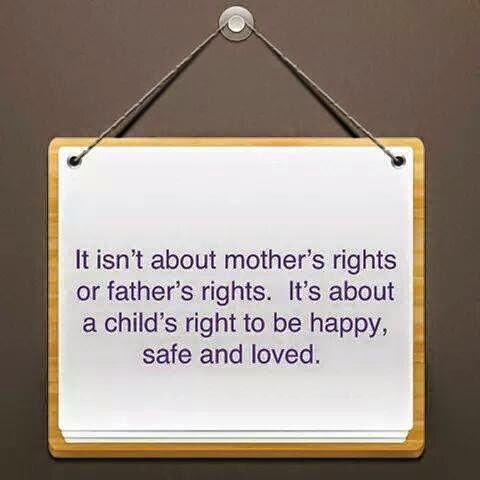
This is not about parental rights over children.
It is about children’s rights to both parents.


Why 50/50 Shared Parenting Should Be the Standard

1. Children Need Both Parents—Consistently

Extensive research shows that children with substantial time and involvement from both parents experience:

  • Better emotional regulation and mental health

  • Higher academic achievement

  • Stronger identity formation

  • Lower rates of anxiety, depression, and risky behavior

Children do best when neither parent is reduced to a visitor.


2. Equal Parenting Reduces Conflict

Contrary to common belief, shared parenting lowers post-separation conflict by:

  • Removing incentives to “win” custody

  • Encouraging cooperation and accountability

  • Reducing litigation and court overload

When courts start from fairness, parents are more likely to act fairly.


3. Gender Neutrality Promotes True Equality

Children benefit when parenting laws:

  • Treat mothers and fathers as equally capable

  • Reflect modern caregiving realities

  • Eliminate outdated assumptions and bias

Equality in parenting strengthens equality in society.


4. Long-Term Outcomes Improve for Everyone

Shared parenting is linked to:

  • Stronger lifelong parent–child bonds

  • Better co-parenting relationships

  • Improved child outcomes well into adulthood

  • Reduced social and economic costs tied to family breakdown

This is preventive public policy, not just family law.


Important Safeguards

A 50/50 standard must include clear exceptions:

  • Documented abuse or neglect

  • Serious substance abuse or untreated mental illness

  • Situations where shared parenting would clearly harm the child

Safety always comes first.
But absence of conflict or imperfection is not a requirement for parenting.


The Principle Is Simple

When both parents are fit and loving, children deserve both—fully, consistently, and without bias.

Make 50/50 shared parenting the starting point, not the uphill battle.

At the core of it all;  it is Human Rights.  Fathers... Mothers...  Both Human beings.   A child born is a Human created... that Human being created from a Father and Mother is going to be here long after breast feeding and long after its first few years of tender care.  The psychological effects of gestation and giving birth are something that a Male parent cannot understand.  This is not a fault or weakness, it is not permission to be treated with less Rights in Parenting.

A baby is born...  Parents are created at this moment too.  That creation process (when parents are born) is special and important.  Human rights are linked to every aspect of Parenting.  To write any laws to reflect gender preference is to define WHICH parent receives more parenting rights.  This is NOT a construct of Equality, it is the construct of social engineering.


Culture is evolving and law is progressive.


Acceptance of Equality

Practice of Equality
Enforcement of Equality

Of course there is people who stand in the way of Progression and Changes in Culture.


The fight is not simply your case... That is your personal battle... and it is extremely important because when you stand up for your rights not just as a father, but as a Human being and Parent.  You are taking a stand in society and showing people that you are not branding yourself in the image that society has cast shadows onto.  Fatherhood...  As a 'Father'  you might have strength, but in court or to Mothers, you might simply trigger stereotypes on a mental & Emotional level.   As a ' Parent ' you are Equal.  As a Human you are Equal.

If you have read finalized court documents you might notice that words can define you.  We all know that words are not truly what defines who you are, ...but on paper... to the courts...    Words can limit your Human Rights.  Stigma and Public Opinion are either enemies or valiant defenders of your case.  Fight for your cause!  and when you do, do it as a Human being fighting for Equal rights as a Parent.

Write your state reps and Write about this.  Whatever wrongs have been inflicted against you,  writing the state and your government about Equal rights for Parents (leaving gender descriptive words to a minimum or out completely) is the first steps in shifting culture and society into a more Equal and positive future for all parents.  Imagine all the young parents who will come after us...  We need to stand together and we will be stronger for it.

SAMPLE LETTER


To: State Legislators

What is more precious: your 14th amendment, basic human right to parent your children or your 2nd amendment right to bear arms? If you had to lose one, which would it be?

“Only lawyers win in the divorce” is the mantra from which Family Law  Statues where written under the false banner of a “child’s best interest.” The lack of a presumptive 50/50 Shared Parenting standard continues to make the divorce industry flourish while children’s lives lay in the ruin. 

By creating this 50/50 Shared Parenting standard, our children and parents will be protected from an industry that creates, promotes and perpetuates conflict for its financial gain. Lives are ruined, lives are lost and injustices beyond comprehension as children are alienated from their parents. 

The presumptive 50/50 Shared Parenting standard is based on an absence of a preponderance of evidence supporting abuse, neglect, addiction or other serious issue as defined by a Court. This fact-based and objective-based approach has to replace the hearsay and subjectively corrupt manner of today's family court processes. 

Given us this single standard can reduce the amount of divorce litigation by half and allow families to move forward with the best interest of all in mind. Help protect parental rights as strongly as gun rights.

It is your duty to introduce legislation establishing a presumptive 50/50 Shared Parenting standard and protect our divorcing families from being exploited by an industry for its own greed.

Sincerely,
[Your name]

Remain an Equal Parent to your Child!

We only support organizations who show an understanding that children need both parents, and that either parent is equally capable of the choice to perpetrate hate or declare peace.

 2/20 

Sunday, June 09, 2013

Depriving your children of love is abuse. So why do it?

The idea of depriving children of love seems almost unthinkable to most parents. After all, love is the foundation of a child’s emotional and psychological development. It nurtures their self-worth, provides security, and helps them navigate the world with confidence. Yet, for various reasons, some parents, whether intentionally or unintentionally, deprive their children of the love and emotional connection they desperately need. This can have devastating consequences for the child’s mental health, social development, and overall well-being.

The question then arises: Why would a parent deprive their child of love, knowing that it is harmful?

The answer is complex and multifaceted, as there are many factors that can contribute to a parent’s inability or unwillingness to provide love. Let’s explore some of the reasons behind this heartbreaking phenomenon.


1. Unresolved Trauma and Emotional Baggage

One of the most common reasons why a parent may be unable to offer love is because they themselves have not experienced healthy love in their own lives. Many parents, especially those who experienced abuse or neglect as children, struggle to give love in the way their children need.

  • Emotional numbness: For parents who were emotionally neglected or abused in their own childhoods, they may not know how to express love in a healthy, nurturing way. The emotional numbness they developed as a survival mechanism can make it difficult for them to connect with their children in the way they need.

  • Generational trauma: Generational trauma is the transmission of trauma from one generation to the next. Parents who were deprived of love or faced emotional abandonment may repeat these patterns with their own children, often unknowingly. Without proper healing or self-awareness, these parents may struggle to break the cycle of neglect or emotional distance.

For these parents, the lack of love they express is not necessarily intentional, but rather a byproduct of their own unhealed wounds.


2. Mental Health Struggles and Emotional Unavailability

Mental health issues such as depression, anxiety, and personality disorders can significantly affect a parent’s ability to be emotionally present for their child. Some common mental health challenges that can lead to emotional unavailability include:

  • Depression: Parents who suffer from depression may be so overwhelmed by their own emotions that they are unable to focus on or respond to their child’s emotional needs. They might feel emotionally exhausted, numb, or disconnected, which makes it hard to provide the nurturing care a child needs.

  • Anxiety: Parents struggling with severe anxiety may focus so intensely on their own worries that they cannot offer their children the emotional support and attention they deserve. In extreme cases, anxiety can cause a parent to withdraw or become overly controlling, creating an emotionally distant or tense home environment.

  • Personality disorders: Disorders such as narcissistic personality disorder or borderline personality disorder can complicate the ability to form healthy, loving attachments. Narcissistic parents, for instance, may prioritize their own needs and desires over their child's emotional well-being, leading to neglect or emotional manipulation.

In these cases, the parent’s mental health challenges may prevent them from engaging in positive, loving interactions with their child. This doesn’t necessarily mean they don’t love their child, but their ability to express that love is severely impaired.


3. Toxic Parenting Styles and Lack of Emotional Awareness

Some parents may unintentionally deprive their children of love due to their own toxic parenting behaviors or a lack of emotional intelligence. These behaviors can arise from ignorance or a failure to recognize how their actions are affecting their child’s emotional development.

  • Authoritarian Parenting: This rigid and controlling parenting style emphasizes obedience, rules, and discipline but often lacks warmth and affection. Authoritarian parents may set high expectations without providing emotional support or love. The focus is on control rather than connection, leading to children who may feel unloved or emotionally abandoned.

  • Neglectful Parenting: Parents who are neglectful (whether emotionally or physically) may be physically present but emotionally unavailable. They fail to meet their child’s emotional needs, offering little affection, praise, or encouragement. Children raised in these environments often feel invisible or unimportant.

  • Over-controlling and critical behavior: Some parents, particularly those who were themselves raised in highly controlling environments, may impose strict rules without fostering emotional closeness. They may criticize their child’s behavior or achievements instead of nurturing them. The child, in turn, may struggle with self-esteem and feel disconnected from their parent.

While these parents may still care about their children, their parenting style is emotionally harmful and does not provide the warmth or love necessary for healthy development.


4. External Stressors and Life Circumstances

External pressures, such as financial stress, marital problems, or a demanding career, can also impact a parent’s ability to show love to their children. When parents are overwhelmed by life’s challenges, they may unintentionally withdraw or become emotionally unavailable.

  • Financial hardship: Parents who are struggling to make ends meet may be so consumed by the pressures of providing financially that they become emotionally distant. The stress of worrying about bills, job security, and other financial concerns can take a toll on a parent’s mental health, making it harder to provide the emotional connection children need.

  • Marital conflict or divorce: Parents who are experiencing marital issues, particularly those going through a divorce or separation, may become emotionally withdrawn or focused on their own needs, leaving their children feeling neglected. They may be too preoccupied with their own emotional turmoil to adequately nurture their children.

  • Work-related stress: Parents who work long hours or are constantly stressed at work may be physically present at home but emotionally unavailable. Fatigue, burnout, or job-related frustrations can drain the emotional energy a parent has to give, leading to a lack of connection with their child.

These external stressors often contribute to emotional neglect. Though the parents may still love their children, their capacity to show that love becomes limited by their own stress and struggles.


5. Intentional Neglect or Emotional Abuse

In some unfortunate cases, intentional emotional abuse or neglect may occur. This can be the result of severe anger, resentment, or toxic belief systems held by the parent. In these situations, the deprivation of love is a deliberate attempt to control, manipulate, or hurt the child. This can manifest in a range of behaviors, from verbal abuse to withholding affection as a form of punishment.

  • Parental alienation: Sometimes, one parent may intentionally try to alienate the child from the other parent, using emotional manipulation or coercion to turn the child against the other parent. This can involve not only withholding affection but also planting seeds of distrust and fear in the child.

  • Punishment by neglect: In extreme cases, a parent may consciously withhold love as a form of punishment, believing that it will make the child more obedient or compliant. This can have devastating consequences for the child’s sense of self-worth and emotional development.

In these instances, the deprivation of love is a form of abuse, and it can cause long-lasting emotional damage to the child.


So, Why Do It?

The simple answer to the question, “Why do it?” is that no parent sets out to intentionally harm their child. In many cases, parents are unaware of the damage their behavior is causing, or they may be acting out of their own unresolved pain, stress, or emotional limitations. They may not realize that their actions—or inaction—are depriving their child of the love and emotional support that is essential for healthy development.

However, regardless of the reasons behind it, depriving a child of love is indeed a form of abuse. Children need love to thrive, to develop healthy emotional connections, and to grow into emotionally stable adults. Parents must recognize the profound impact their behavior has on their children and take steps toward healing, whether it’s seeking therapy, learning about healthy emotional communication, or working to break harmful cycles of neglect.


Conclusion: The Path to Healing and Change

While there are many complex reasons why a parent might deprive a child of love, the good news is that healing is possible. Parents who recognize their own emotional struggles or toxic patterns can take proactive steps toward improvement. Therapy, self-reflection, and support systems can help parents become more emotionally available, offering their children the love and support they need to thrive.

Children, especially those who have experienced emotional neglect, can also heal through therapy, strong supportive relationships, and environments that encourage emotional expression and self-esteem.

Deprivation of love is devastating—but awareness, support, and change can help parents and children break free from cycles of emotional harm and foster healthier, more loving relationships.

Post by Parental Alienation Awareness Organization - PAAO.


Uploaded on Jan 24, 2012

World4Justice : NOW! Lobby Forum.Family Law and Child Welfare Reform.


Remain an Equal Parent to your Child!


We only support organizations who show an understanding that children need both parents, and that either parent is equally capable of the choice to perpetrate hate or declare peace.

The International Access and Visitation Centers conference was held in Toronto in April of 2013 The PAAO was there and spoke to most of the 200 or so practitioners. Of course all were familiar with alienation and it's results. Everyone was not only gratified to see PAAO at the event, they all also acknowledged that PA is either a form of Domestic violence or on the continuum of Domestic Violence behaviors.

Saturday, June 08, 2013

Family Courts Must Stop Reinforcing Alienation

Parental Alienation: The Hidden Harm Courts Must Confront

In recent cases I’ve handled, the outward behavior of an alienating parent often appears harmless — even reasonable — yet the impact on the parent-child relationship is devastating.

Take this example: a mother “delivers” her three sons, ages 15, 13, and 11, to the hallway outside her apartment when their father arrives for parenting time. The boys refuse to go. The mother shrugs, saying, “I’m sorry, they just don’t want to go with you,” and ushers them back inside.

Her attorney asks, “What else is she supposed to do?”

The answer is simple: the children would not have reached this point without the mother’s influence. Alienation does not happen in a vacuum. Undoing the damage is extraordinarily difficult, because once children are conditioned to reject a parent, even neutral settings — like a school pickup — may not break the cycle.

The Brutality Beneath the Surface

What looks like passive compliance is, in reality, brutal manipulation. The mother has subtly — or aggressively — conveyed to the children that time with their father is unnecessary, even undesirable. This is parental alienation: a process that erodes affection and convinces children that one parent is irrelevant.

Alienating parents often justify their actions by pointing to alleged flaws in the other parent: anger, laziness, dishonesty, infidelity, even violence. But children raised by imperfect parents still love them, seek their affection, and cherish their presence. A truly “bad” parent drifts away naturally. Alienation is not needed. The fact that the targeted parent is deeply involved is precisely why alienation must be manufactured.

Remedies That Actually Work

So, what can be done? Courts often hesitate, asking what the alienating parent could do differently. The first step is accountability. If a father must bring the issue to court, the mother should pay his attorney fees. Without consequences, alienation continues unchecked.

But financial penalties alone rarely suffice. Realistically, only three remedies have proven effective:

  1. Financial sanctions — awarding attorney fees or offsetting child support.

  2. Incarceration — drastic, but often necessary when fines fail to deter alienation.

  3. Change of custody — the most effective remedy, giving children the chance to rebuild their relationship with the alienated parent.

Anything short of these measures leaves the alienating parent in control, and the children deprived of what they need most: a genuine bond with both parents.

Courts Must Stop Reinforcing Alienation

Too often, courts craft “band-aid” solutions that reinforce the problem. They delay meaningful remedies until the alienated parent is financially drained and unable to continue the fight. By then, the parent is erased from the child’s life. Both lose.

Attorneys representing alienated parents must educate the courts. Judges need to understand that alienation is not a minor inconvenience — it is internal bleeding in the parent-child relationship. Superficial remedies will not stop it. Strong, decisive action must be taken early, before the damage becomes irreversible.

The Call to Action

Parental alienation is one of the most insidious forms of child abuse. It thrives in silence, cloaked in seemingly benign actions. Courts must recognize it for what it is and respond with remedies that truly protect children’s right to both parents. Anything less is not justice — it is complicity.

Millions of Daughters do not have contact with their biological fathers in the U.S and around the globe, and can not benefit from the positive influences this core relationship provides.

3-Types of Father-Daughter Alienation:

Its impact on Paradigm Development

By Karen Davis-Johnson, M.A., Editor for The Journal of Father Daughter Communications 

A Google Blog

Means we use must be as pure as the ends we seek.

Abuse (7) Abuse of power (1) Abuse of process (5) Admission to practice law (3) Adversarial system (84) Advocacy group (3) African American (1) Alienator (1) Alimony (7) All Pro Dad (2) All rights reserved (1) Allegation (2) Alliance for Justice (2) American Civil Liberties Union (3) American Psychological Association (1) Americans (2) Anecdotal evidence (2) Anti-discrimination law (1) Arrest (1) Bar association (1) Best interests (42) Bill (law) (1) British Psychological Society (1) Broward County (1) Broward County Public Schools (3) Brown University (1) Catholic Church (1) Center for Public Integrity (2) Chief judge (26) Child Abuse (48) Child custody (76) Child development (4) Child neglect (3) Child protection (14) Child Protective Services (18) Child Support (62) Children (3) Children's Rights (85) Christine Lagarde (1) Christmas (3) Circuit court (3) Civil and political rights (14) Civil law (common law) (1) Civil liberties (9) Civil Rights (145) Civil rights movement (1) Class action (1) Communist Party of Cuba (1) Confidentiality (1) Constitutional law (1) Constitutional right (5) Contact (law) (11) Contempt of court (4) Convention on the Rights of Persons with Disabilities (1) Coparenting (31) Copyright (1) Copyright infringement (1) Corruption (1) Court Enabled PAS (95) Court order (2) Cuba (1) Cuban Missile Crisis (1) Cuban Revolution (1) Custodial Parent (1) custustodial Parent (1) Declaratory judgment (3) Denial of Reasonable Parent-Child Contact (117) Diagnostic and Statistical Manual of Mental Disorders (2) Divorce (123) Divorce Corp (5) Divorce Court (1) Documentary (24) Domestic Violence (51) Dr. Stephen Baskerville (5) Dred Scott v. Sandford (1) DSM-5 (1) DSM-IV Codes (1) Due Process (44) Due Process Clause (1) Dwyane Wade (1) Easter (1) Equal-time rule (2) Ethics (1) Events (9) Exposé (group) (1) Facebook (20) Fair use (1) False accusation (4) False Accusations (58) famil (1) Family (1) Family (biology) (2) Family Court (200) Family Law (112) Family Law Reform (118) Family Rights (87) Family therapy (10) Father (14) Father figure (3) Father's Day (1) Father's Rights (16) Fatherhood (109) Fatherlessness Epidemic (5) Fathers 4 Justice (3) Fathers' rights movement (48) Fidel Castro (1) Florida (215) Florida Attorney General (7) Florida Circuit Courts (19) florida lawyers (30) Florida Legislature (6) Florida Senate (11) Foster care (1) Fourteenth Amendment to the United States Constitution (1) Fraud (1) Free Speech (1) Freedom of speech (1) Frivolous litigation (1) Fundamental rights (14) Gainesville (1) Gender equality (1) Government Accountability Project (2) Government interest (2) Grandparent (4) Havana (1) Healthy Children (14) Human Rights (121) Human rights commission (1) I Love My Daughter (56) I Love My Son (9) Injunction (1) Innocence Project (1) Investigative journalism (1) Jason Patric (2) JavaScript (1) Joint custody (7) Joint custody (United States) (18) Judge (5) Judge Judy (7) Judge Manno-Schurr (56) Judicial Accountability (103) Judicial Immunity (7) Judicial misconduct (10) Judicial Reform (4) Judicial Watch (2) Judiciary (3) Jury trial (1) Kids for cash scandal (1) Law (2) Lawsuit (9) Lawyer (8) Legal Abuse (149) Liar Joel Greenberg (17) Linda Gottlieb (1) Litigant in person (1) Little Havana (1) Marriage (6) Matt O'Connor (1) Men's rights movement (1) Mental disorder (1) Mental health (2) Meyer v. Nebraska (1) Miami (44) Miami-DadCounty (1) Miami-Dade County (7) Miami-Dade County Public Schools (2) Miscarriage of justice (42) Mother (4) Motion of no confidence (1) Movie (4) Music (8) Nancy Schaefer (1) National Fatherhood Initiative (1) Natural and legal rights (1) News (86) Nixa Maria Rose (17) Non-governmental organization (1) Noncustodial parent (5) Organizations (58) Palm Beach County (1) Parent (37) Parental Alienation (119) Parental alienation syndrome (19) Parental Rights (37) Parenting (15) Parenting plan (6) Parenting time (6) Parents' rights movement (38) Paternity (law) (1) Personal Story (23) Pierce v. Society of Sisters (1) Pope (1) Posttraumatic stress disorder (29) President of Cuba (1) President Trump (1) Pro Se (28) Pro se legal representation in the United States (3) Prosecutor (1) Protest (1) Psychological manipulation (1) Psychologist (1) Public accommodations (1) Public Awareness (106) Raúl Castro (1) Re-Post/Re-Blog (12) Research (1) Restraining order (4) Rick Scott (12) Second-class citizen (1) Self Representation-Pro Se (31) Sexism (1) Sexual abuse (2) Sexual assault (1) Shared Parenting (93) Single parent (6) Skinner v. Oklahoma (1) Social Issues (60) Social Media (1) Spanish (8) Stand Up For Zoraya (48) State school (2) Student (1) Supreme Court of Florida (8) Supreme Court of the United States (5) Tampa (1) Testimony (23) Thanksgiving (1) The Florida Bar (10) The Good Men Project (1) Trauma (4) Troxel v. Granville (2) True Story (21) Turner v. Rogers (1) United States (26) United States Congress (1) United States Constitution (1) United States Department of Justice (4) Videos (49) Violence Against Women Act (1) Whistle-blower (3)